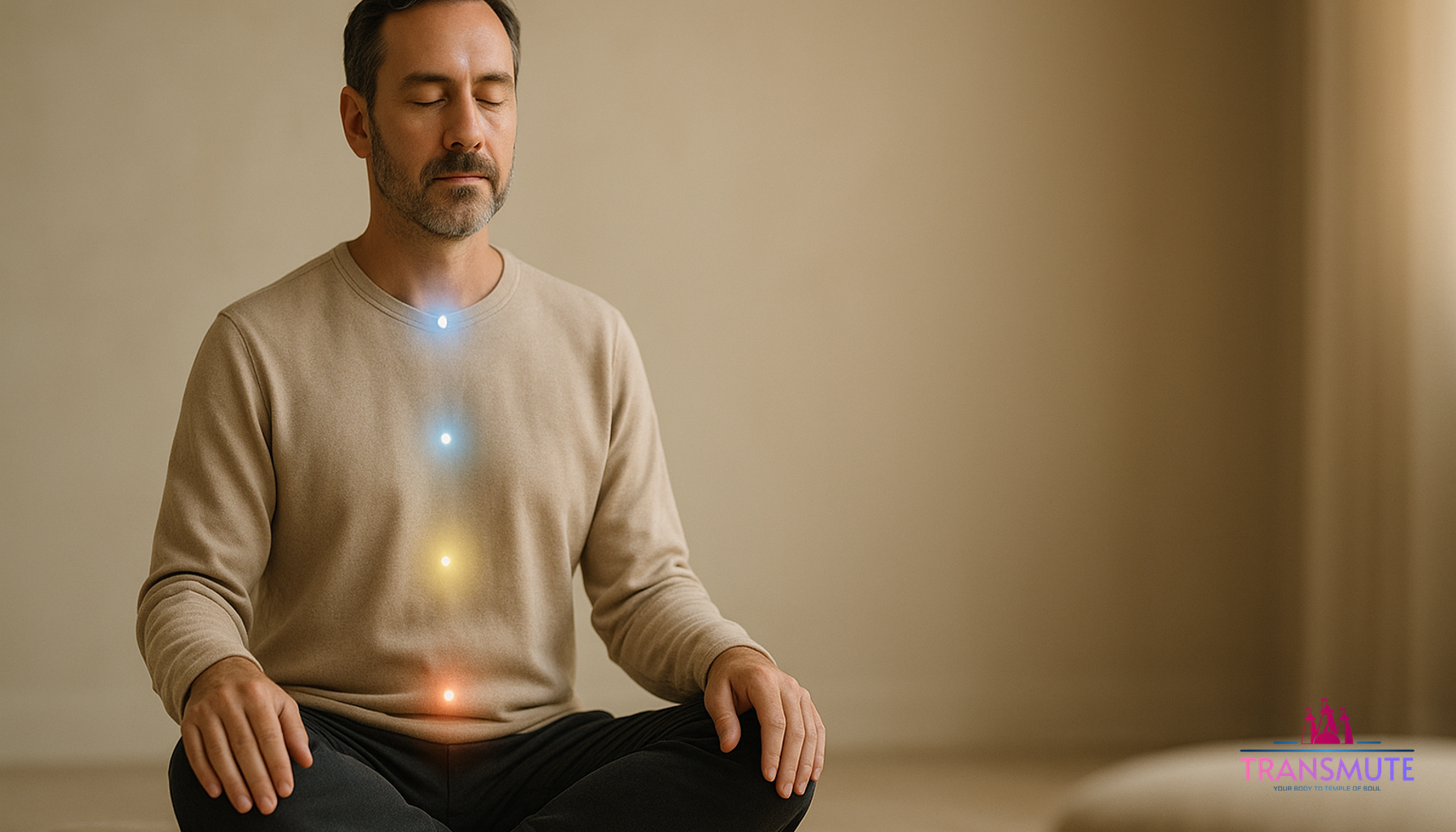
Chakra Healing for Anxiety: The Anxiety Four and a 5-Minute Routine
You're two minutes from a meeting, or a hard conversation, or just lying in bed with your mind refusing to slow down — and your chest feels tight, your thoughts are looping, and you can't quite locate where the feeling is even coming from. If you've read about chakras before, you might wonder whether there's something more targeted you can do than working through all seven, one at a time.
There is. Chakra healing for anxiety doesn't have to mean working through all seven chakras — not every chakra carries equal weight when anxiety specifically is what you're dealing with. This guide introduces the Anxiety Four — the four chakras most closely tied, in tradition, to the specific feelings anxiety brings up — along with one stacked routine you can use both in the moment and as a daily habit.
Chakra Healing for Anxiety: Why Only Some Chakras Matter Most
Our guide to [chakra healing for beginners] walks through all seven chakras, root to crown, because that's the right approach when you're getting oriented to the whole system. But anxiety isn't a whole-system problem — it tends to cluster around a few specific themes: feeling unsafe, feeling out of control, not being able to speak up, and a mind that won't stop spinning.
Introducing the Anxiety Four
Traditionally, four of the seven chakras map most directly onto those exact themes:
- Root Chakra — safety and stability
- Solar Plexus Chakra — control and personal power
- Throat Chakra — voice and self-expression
- Third Eye Chakra — clarity and racing thoughts
Narrowing to these four isn't about skipping the others — it's about giving you a faster, more focused starting point when anxiety is the specific thing you're dealing with right now.
The Anxiety Four, One at a Time
Root Chakra — Safety
Anxiety often shows up as a vague, hard-to-place worry about safety or stability, even when nothing is objectively wrong. Traditionally, that feeling sits with the root chakra.
Practice: Plant both feet flat on the floor. Spend 30 seconds just noticing the contact between your feet and the ground, breathing slowly — a classic grounding technique from both yoga and Reiki self-treatment.
Solar Plexus Chakra — Control
The specific flavor of anxiety that feels like losing control, or bracing for something to go wrong, traditionally maps to the solar plexus.
Practice: One hand on your upper abdomen, take three slow breaths, and silently repeat one honest, steadying phrase — "I can handle what's next" works well because it doesn't promise everything will be fine, just that you can meet it.
Throat Chakra — Voice
Anxiety about saying the wrong thing, or swallowing what you actually want to say, is the throat chakra's traditional territory.
Practice: Hum gently for 15 seconds. The vibration is traditionally linked to clearing this chakra, and it has the added practical effect of releasing tension in the jaw — a common place anxiety physically lodges itself.
Third Eye Chakra — Racing Thoughts
Mental fog, or thoughts that won't stop looping, sits with the third eye in tradition.
Practice: Close your eyes and rest two fingertips lightly on your forehead for 30 seconds of slow breathing — a simple stillness cue used to settle an overactive mind.
The Stacked 5-Minute Anxiety Routine
Instead of choosing just one, try all four in sequence — roughly one minute each, plus a minute to settle at the start and end:
- Settle (1 min): Sit or stand comfortably, eyes open or closed, and take three slow breaths.
- Root (1 min): Feet flat, notice the ground.
- Solar Plexus (1 min): Hand on abdomen, repeat your steadying phrase.
- Throat (1 min): Hum gently.
- Third Eye (1 min): Fingertips to forehead, breathe slowly.
That's the full Anxiety Four routine, stacked into one five-minute practice rather than four separate ones to pick between.
In-the-Moment (60 Seconds) vs. Daily Practice (5 Minutes)
Some moments call for speed, others for depth — both versions use the same four chakras, just at different paces.
- In-the-moment (60 seconds): When anxiety spikes right now — before a meeting, mid-conversation, lying awake — do just 15 seconds per step: feet on the ground, hand on abdomen, one hum, fingertips to forehead.
- Daily practice (5 minutes): When you have a quiet moment set aside, use the full stacked routine above as a short daily habit, the same way you might use a few minutes of stretching or journaling.
Neither version requires belief in energy healing to feel calming — the breathing, grounding, and gentle touch involved have value on their own, chakra framework or not.
Where to Go Next
If this is your first time encountering chakras at all, start with our full [chakra healing for beginners] guide for the complete Root-to-Crown Practice Map across all seven. If you want the fuller picture of how a professional or self-administered Reiki session works — including what the research says — see our guide to [Reiki for anxiety]. This piece sits between the two: the focused, anxiety-specific starting point.
Frequently Asked Questions (FAQ)
Which chakras are linked to anxiety?
Traditionally, the root (safety), solar plexus (control), throat (voice), and third eye (racing thoughts) are considered the four most closely tied to anxiety-related themes — what this guide calls the Anxiety Four.
Can a blocked chakra cause anxiety?
No — this reverses cause and effect in a way evidence doesn't support, and it can be genuinely unhelpful if it makes you feel responsible for a real anxiety condition. Chakra work is a reflective, complementary practice, not a diagnosis or explanation for clinical anxiety.
What's the fastest chakra exercise for anxiety in the moment?
The 60-second version above — feet on the ground, hand on abdomen, one hum, fingertips to forehead — condenses all four practices to about 15 seconds each.
How is chakra healing for anxiety different from a full Reiki session?
A full Reiki session (self-administered or with a practitioner) typically moves through all seven chakras in sequence over 20–60 minutes. This routine narrows to just the four most relevant to anxiety and takes about five minutes.
Do I need to work on all seven chakras if I only have anxiety?
Not necessarily. The Anxiety Four is designed as a focused starting point — you can always explore the remaining three later using our beginners' guide.
What does it feel like when the solar plexus chakra is "blocked"?
Traditionally described as self-doubt, a sense of losing control, or difficulty asserting yourself — a reflection prompt to notice, not a clinical symptom.
Is chakra healing for anxiety backed by science?
The chakra framework itself is a traditional belief system, not a scientifically measured one. That said, the individual techniques involved — slow breathing, grounding, gentle touch, brief vocalization — are independently supported by general research on stress and relaxation, regardless of the chakra framing.
How often should I do a chakra practice for anxiety?
There's no fixed rule. Many people use the 60-second version as needed during anxious moments and the 5-minute version once daily as a standing habit.
Key Takeaways
Anxiety doesn't require working through all seven chakras — traditionally, four of them (root, solar plexus, throat, third eye) map most directly onto the specific feelings anxiety brings up: unsafety, loss of control, unspoken words, and racing thoughts. The Anxiety Four routine stacks one simple practice for each into a single five-minute sequence, with a 60-second version for anxious moments and the full version as a daily habit. None of this replaces professional care — it's a complementary, low-pressure practice to reach for alongside it.
Disclaimer
This article describes chakras as they are understood within yogic and Reiki tradition — a belief system and reflective framework, not a scientifically validated or medically diagnostic one. It is for educational and reflective purposes only and is not a substitute for professional medical or mental health care. If you're experiencing persistent anxiety, panic attacks, or other ongoing emotional difficulty, please speak with a qualified healthcare provider.
Leave a Reply