When I mention chakras to someone with a science background, I notice something happen. A slight tightening. A polite scepticism. The unspoken thought — “here comes the woo woo.”
I understand it. I had the same reaction once. But then I started looking at the research. And what I found was genuinely surprising — the overlap between ancient maps and modern measurements is too precise to be coincidence.
“The rishis who mapped the chakra system 3000 years ago did not have MRI machines or bioelectromagnetic sensors. And yet — they were mapping something real.”
The word chakra means “wheel” in Sanskrit — a rotating vortex of energy. The classical tradition describes seven primary chakras running along the spine, from the base (Muladhara) to the crown (Sahasrara).
But here is the key thing most Western interpretations miss — chakras were never described as physical structures. They were described as nodes in the pranic body — the energy body that interpenetrates and animates the physical. Functional centres — places where energy concentrates, distributes, and processes.
This distinction matters enormously. When scientists looked for chakras as physical organs and found nothing, they declared the whole system mythology. But that’s like looking for a magnetic field with your eyes and declaring magnetism doesn’t exist.
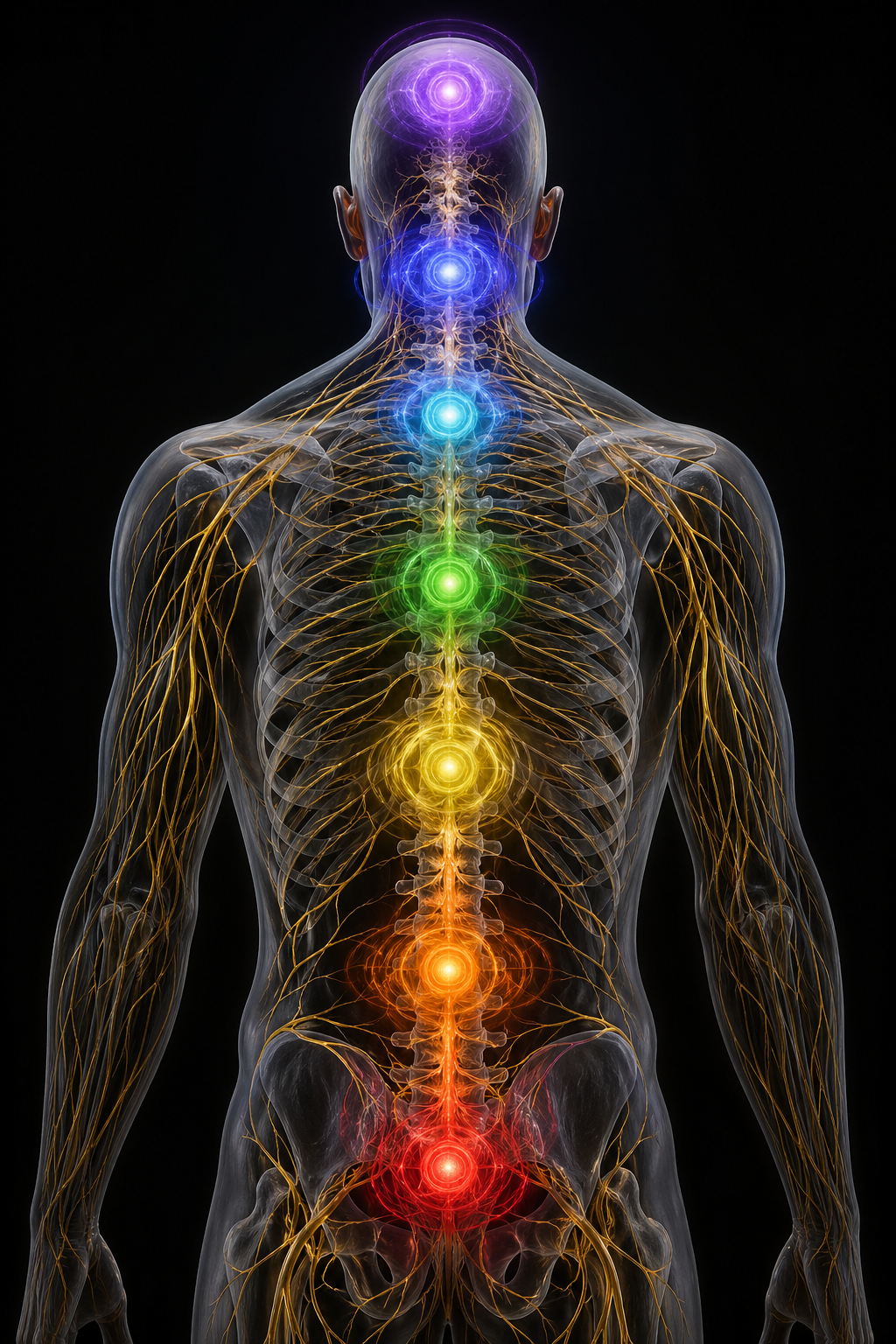
The human body generates measurable electromagnetic fields. The heart alone generates a field detectable several feet outside the body — measured by the magnetocardiograph. The body’s surface emits biophotons — actual light particles — at intensities correlated with biological activity.
These are not metaphors. They are measured, reproducible, peer-reviewed findings. The body is not just a biochemical machine — it is also an electromagnetic system.
Biophysicist Dr. Valerie Hunt at UCLA measured high-frequency energy fields at the body’s surface using EMG electrodes. She found that the locations of highest electromagnetic activity corresponded precisely with the classical chakra locations — independently, without prior knowledge of the chakra system. The frequencies at chakra locations were significantly higher than those found elsewhere on the body.
Even at the purely physical level, the correlation is striking. The seven classical chakra locations correspond almost exactly with the locations of the major nerve plexuses along the spine:
| Chakra | Location | Nerve Plexus | Physical Organs |
|---|---|---|---|
| Muladhara | Base of spine | Coccygeal Plexus | Adrenal glands, kidneys |
| Svadhisthana | Sacral region | Sacral Plexus | Reproductive organs |
| Manipura | Solar plexus | Solar / Celiac Plexus | Liver, stomach, pancreas |
| Anahata | Heart centre | Cardiac Plexus | Heart, lungs, thymus |
| Vishuddha | Throat | Pharyngeal Plexus | Thyroid, vocal cords |
| Ajna | Between eyebrows | Cavernous Plexus | Pituitary, pineal, eyes |
| Sahasrara | Crown of head | Cerebral Cortex | Brain, nervous system |
The precision of this correspondence — across thousands of years and entirely different knowledge systems — is remarkable. The tradition was not inventing locations arbitrarily. It was mapping the concentrations of neural and energetic activity that happen to be real.
Each chakra also corresponds to a major endocrine gland. The Manipura chakra governs the adrenal glands — and is associated with fear and personal power. Modern endocrinology confirms adrenal glands produce cortisol and adrenaline — activated precisely in states of fear.
The Anahata chakra is associated with love and grief. Its corresponding gland — the thymus — is the master gland of the immune system. Research confirms emotional states like grief and love directly regulate thymus function.
3000+Years the chakra system has been documented in Vedic tradition 7/7Chakra locations that correspond to major nerve plexuses 100%Chakra-to-endocrine gland correspondence with known physiologyHere is what I want to say clearly — the science does not prove everything the tradition claims about chakras. It does not prove that chakras spin, that they have specific colours, or that they can be seen by clairvoyants.
What the science does confirm — there are real, measurable, electromagnetic and neurological concentrations at the classical chakra locations. The ancient tradition was mapping something that modern instruments are only beginning to measure.
But the more important point — the proof that matters most is experiential, not intellectual.
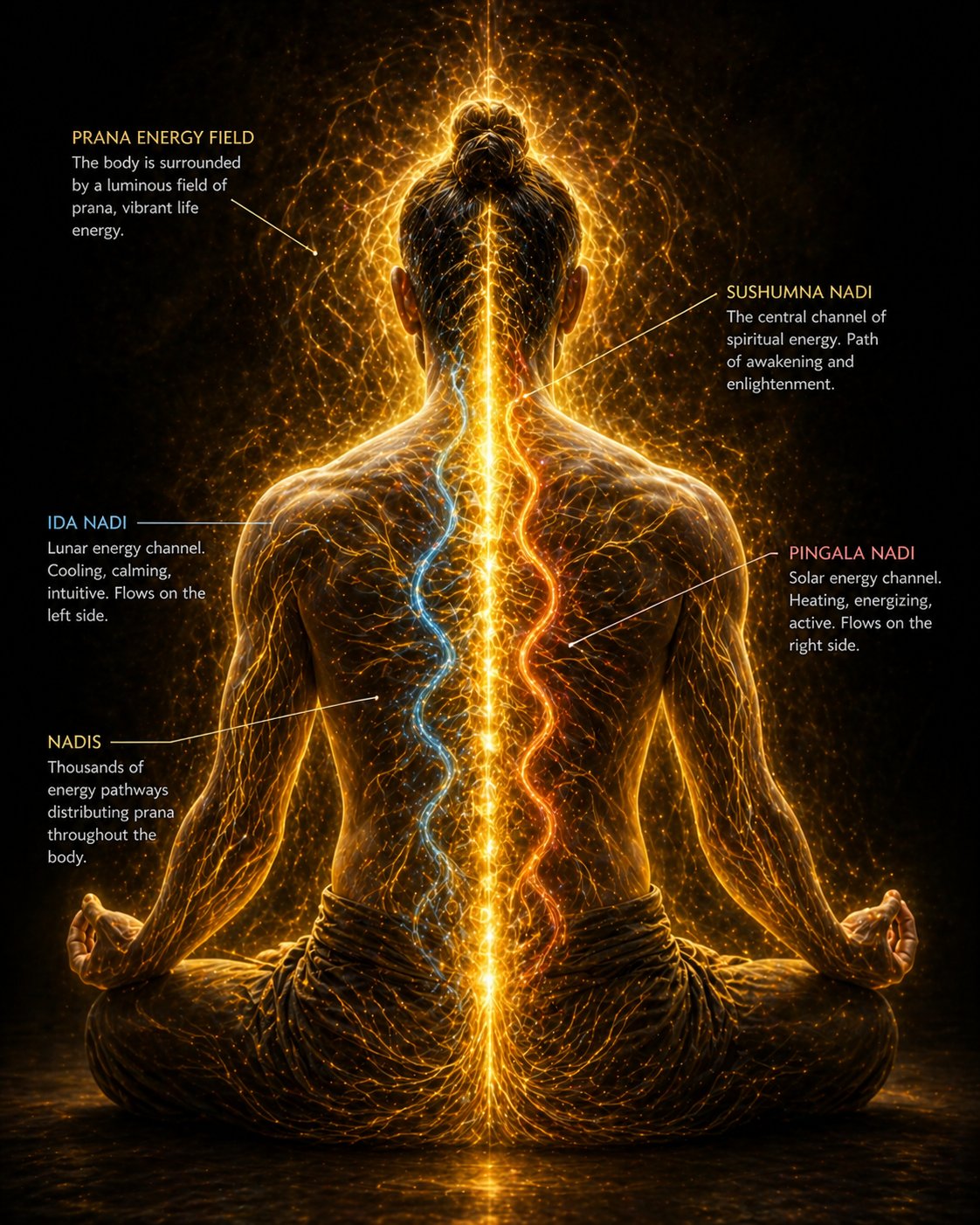
Whether you call them chakras or nerve plexuses or electromagnetic nodes — the practical implication is the same. The body has concentrated centres of energetic and neurological activity. When these are blocked or dysregulated — disease follows.
The heart centre carrying unresolved grief → chronically suppressed immune function. The solar plexus locked in fear → overactive adrenal response → cortisol dysregulation → anxiety, gut problems, inflammation.
When we work with the chakra system in Reiki and energy healing — we are not doing something separate from the body. We are working directly with its electromagnetic, neural, and endocrine reality. The ancient map turns out to be a precise map of the body’s most important functional centres. The language was different. The territory was the same.
“Science and the ancient tradition are not in opposition. They are two blind men describing the same elephant — one with instruments, one with direct experience. The elephant is real.”
Understanding chakras intellectually is one thing. Feeling a blocked energy centre release — the warmth, the shift, the clarity that follows — is another. Sudhanshu works individually with Reiki, EFT, and Pranic healing to clear what words cannot reach.
Request a Conversation →Reiki Master · EFT Practitioner · Self-Hypnosis · Raj Yog · Manifestation. Founder of Transmute Yourself — Delhi NCR. Working individually with people dealing with anxiety, chronic illness, emotional pain, and the desire for deeper inner transformation.
Sab Prabhu kripa se. Mera aur mera uspe koi adhikar nahi.